
Home › FemiCore Ingredients
FemiCore Ingredients: What's Inside and What the Research Says
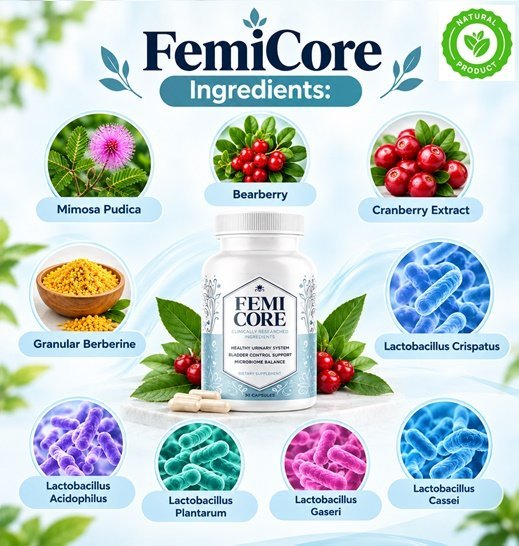
FemiCore combines five Lactobacillus probiotic strains with four botanicals. This guide explains what each ingredient does, why it's in the formula, how strong the research is and what safety points to know.
Want the short version? See what FemiCore is and how it works, or jump to our FemiCore review for the overall verdict.

FemiCore ingredients at a glance
Most women's urinary supplements rely on one active ingredient, usually cranberry or D-mannose. FemiCore takes a broader approach: probiotics to rebuild protective bacteria, plus botanicals that work on bacteria adhesion, bacterial growth and gut health.
The reasoning comes from microbiome research. A 2014 study in mBio found that women with urgency urinary incontinence often had a different bladder microbiome than women without symptoms. And in a healthy vaginal microbiome, Lactobacillus species, especially L. crispatus, usually dominate.
| Ingredient | Type | Main role | Evidence |
|---|---|---|---|
| L. crispatus | Probiotic | Keeps vaginal pH low | Moderate |
| L. acidophilus | Probiotic | Competes with pathogens | Limited |
| L. plantarum | Probiotic | Survives digestion | Limited |
| L. gasseri | Probiotic | Vaginal colonization | Limited–moderate |
| L. casei | Probiotic | Immune support | Limited |
| Cranberry extract | Botanical | Stops E. coli sticking | Moderate |
| Uva ursi | Botanical | Urinary antimicrobial | Limited |
| Berberine | Botanical | Antibacterial, bladder activity | Early |
| Mimosa pudica | Botanical | Gut support | Early |
Evidence ratings refer to research on urinary and vaginal health specifically. "Moderate" means supported by randomized trials or systematic reviews; "limited" means small or mixed studies; "early" means mostly lab or animal research.
The 5 probiotic strains in FemiCore
Many probiotic supplements are built for digestion, using strains such as L. rhamnosus or Bifidobacterium. FemiCore leans toward species associated with vaginal health. One general point applies to all five: probiotic effects are strain-specific, so research on one strain of a species doesn't automatically apply to another strain with the same name.
Lactobacillus crispatus
What it does
L. crispatus is the most common protective bacterium in a healthy vaginal microbiome. It produces large amounts of lactic acid, which keeps vaginal pH around 3.8 to 4.5. That acidity makes it harder for E. coli and other pathogens to grow near the urethra.
Why it's in FemiCore
When L. crispatus is depleted by antibiotics, falling estrogen or other disruptions, pH rises and harmful bacteria gain ground. FemiCore is built around replacing this strain, which makes it the single most important ingredient in the formula.
What the research says
It is the best-studied probiotic for UTI prevention. In a 2011 phase 2 trial in Clinical Infectious Diseases, women with recurrent UTIs who used a vaginal L. crispatus product had fewer recurrences than those on placebo. That trial used a vaginal suppository, so results for an oral capsule may differ.
Lactobacillus acidophilus
What it does
One of the most familiar probiotic species. It produces lactic acid and competes with harmful bacteria for space and nutrients, mainly in the gut.
Why it's in FemiCore
The rectum is a major reservoir for the E. coli that cause UTIs. Supporting healthy gut flora may reduce how many pathogens are available to reach the urinary tract, often called the gut-vaginal-bladder axis.
What the research says
Lab studies show L. acidophilus can interfere with E. coli. Clinical trials on UTIs are limited and mixed, and most of its research is about digestive health.
Lactobacillus plantarum
What it does
L. plantarum is a hardy strain that tolerates stomach acid and bile better than many probiotics, so more live bacteria reach the intestine.
Why it's in FemiCore
A probiotic only helps if enough of it survives digestion. Plantarum adds a resilient strain to the mix and produces its own antimicrobial compounds.
What the research says
Small studies suggest a possible role in urinary and vaginal health, but results depend heavily on the specific strain used. Large trials on UTI prevention are lacking.
Lactobacillus gasseri
What it does
L. gasseri is one of the Lactobacillus species naturally found in the vaginal tract. It produces lactic acid and bacteriocins, proteins that inhibit competing bacteria.
Why it's in FemiCore
It works alongside L. crispatus to keep the vaginal environment acidic. A balanced vaginal microbiome matters for UTIs because bacterial vaginosis is linked to higher UTI risk.
What the research says
Most research on L. gasseri focuses on bacterial vaginosis and vaginal health rather than UTIs directly. Findings there are encouraging but not conclusive.
Lactobacillus casei
What it does
L. casei is mainly studied for supporting immune function and overall microbiome diversity.
Why it's in FemiCore
The idea is to help the microbiome stay stable through stress, diet changes or antibiotic courses, rather than collapsing each time.
What the research says
Research on L. casei is mostly about gut and immune health. There is little direct evidence for bladder or UTI outcomes.
The 4 botanicals in FemiCore
The botanicals act on different targets from the probiotics, and they don't need weeks to settle in. Two of them, uva ursi and berberine, also carry the most important safety considerations in the formula.
Cranberry extract (PACs)
What it does
Cranberry contains proanthocyanidins (PACs), which can stop E. coli from attaching to the cells lining the bladder and urethra. Bacteria that can't attach are more easily flushed out when you pee.
Why it's in FemiCore
It adds a fast-acting, well-studied layer of protection that doesn't depend on probiotics settling in first.
What the research says
A 2023 Cochrane review of 50 trials found cranberry products reduced the risk of repeat UTIs in women with recurrent infections. Many studies use extracts standardized to around 36 mg of PACs a day. Check the label below for FemiCore's cranberry amount and whether PAC content is stated.
Safety notes
Generally well tolerated. People taking warfarin should talk to their doctor, as large amounts of cranberry have been reported to affect its action.
Uva ursi (bearberry)
What it does
Uva ursi leaf contains arbutin. After it is absorbed, the body converts it into hydroquinone, which has antimicrobial activity in the urine.
Why it's in FemiCore
It complements cranberry: cranberry helps stop bacteria from sticking, while uva ursi acts against bacteria already present.
What the research says
Uva ursi has a long history of traditional use for urinary complaints, and the European Medicines Agency recognizes it as a traditional herbal medicine for mild lower urinary tract symptoms. Modern clinical trials are few and small.
Safety notes
This is the ingredient that needs the most care. The EMA monograph recommends using uva ursi for no more than about one week at a time and no more than five times a year, because of hydroquinone exposure. It is not advised during pregnancy, breastfeeding, for children or with kidney disease. Since FemiCore is marketed for months of daily use, compare the uva ursi amount on the label with your doctor or pharmacist.
Berberine
What it does
Berberine is a plant compound found in herbs such as goldenseal and barberry. It has antibacterial effects in lab studies, and animal research suggests it may reduce overactive bladder muscle contractions.
Why it's in FemiCore
It is included mainly for urgency and leaks, the bladder-control side of FemiCore's claims, along with extra antibacterial support.
What the research says
Evidence for bladder control comes mostly from lab and animal studies. We are not aware of good human trials on berberine for overactive bladder. The sales page describes it as "granular" berberine, but we found no published data showing this form is absorbed better.
Safety notes
Berberine can lower blood sugar and affects liver enzymes that break down many medications. Talk to your doctor if you take diabetes medication, blood pressure medication, blood thinners, cyclosporine or other prescriptions. It should be avoided in pregnancy and while breastfeeding.
Mimosa pudica
What it does
Mimosa pudica, sometimes called the sensitive plant, has been used in traditional medicine for digestive complaints.
Why it's in FemiCore
It is meant to support the gut, which influences the vaginal and urinary microbiome.
What the research says
Most research is in animals or the lab, showing possible anti-inflammatory and gut-protective effects. Human clinical data is minimal.
How FemiCore's ingredients work together
The formula is designed around different mechanisms that act on different timescales. This is the intended logic; it has not been tested as a combination in a published trial.
- Early support, first weeksCranberry PACs and uva ursi act on bacteria directly and don't depend on colonization.
- Rebuilding flora, weeks 2–6The five Lactobacillus strains aim to settle in the gut and, for some strains, reach the vaginal tract, producing lactic acid and lowering pH.
- Maintaining balance, weeks 6–12 and beyondL. casei and mimosa pudica support gut stability, with the aim of keeping protective flora in place through stress, antibiotics or hormonal change.
Can oral probiotics reach the vagina at all? Some strains have been shown to, likely by passing through the gut and colonizing nearby skin first. But it depends on the exact strain, which is why results from one probiotic product can't be assumed for another.
FemiCore ingredient safety and interactions
Most healthy adults tolerate probiotics well; mild bloating in the first week or two is the most common side effect. The table below sums up the ingredient-specific points worth discussing with your doctor or pharmacist.
| Ingredient | Main caution | Who should ask a doctor first |
|---|---|---|
| Probiotic strains | Rare infections in very ill people | Weakened immune system, central line, serious illness |
| Cranberry extract | Possible effect on warfarin | People on blood thinners |
| Uva ursi | Advised for short courses only | Pregnancy, breastfeeding, kidney disease, long-term users |
| Berberine | Lowers blood sugar; drug interactions | Diabetes, blood pressure or blood-thinning medication, pregnancy |
| Mimosa pudica | Little safety data | Pregnancy and breastfeeding |
Is the FemiCore formula well designed?
Mostly, yes. The two ingredients with the strongest evidence for recurring UTIs, L. crispatus and cranberry, are both included, and the probiotic choice leans toward vaginal health rather than digestion. Each ingredient has a distinct job, so the formula avoids padding with near-duplicates.
Two things hold it back. Berberine and mimosa pudica rest on early research, so the bladder-control side of the formula is less proven than the UTI side. And uva ursi, which is meant for short courses, sits in a product designed for months of use. Compare the amounts on the label with your pharmacist, especially if you plan to take FemiCore long term.
FemiCore ingredients FAQ
What are the ingredients in FemiCore?
FemiCore contains nine ingredients: five Lactobacillus probiotic strains (L. crispatus, L. acidophilus, L. plantarum, L. gasseri and L. casei) and four botanicals (cranberry extract, uva ursi, berberine and mimosa pudica).
What is the most important ingredient in FemiCore?
Lactobacillus crispatus. It is the main protective bacterium in a healthy vaginal microbiome and the best-studied strain for preventing recurrent UTIs. Cranberry extract is the second most important, with good evidence for reducing repeat UTIs.
Are FemiCore's ingredients safe?
The probiotic strains are safe for most healthy adults. Uva ursi is generally advised for short courses only, and berberine can interact with diabetes, blood pressure and blood-thinning medications. Check with your doctor if you are pregnant, breastfeeding or on medication.
Can the probiotics in FemiCore reach the vagina if taken by mouth?
Some oral probiotic strains have been shown to reach the vaginal tract, likely by passing through the gut first. This depends on the specific strain, so results from one product can't be assumed for another.
Does FemiCore contain D-mannose?
No. FemiCore does not list D-mannose. Its anti-adhesion support comes from cranberry proanthocyanidins (PACs).
Is FemiCore vegan or allergen-free?
Check the Supplement Facts label and the official product page for the capsule material and allergen information, as these can change between batches.
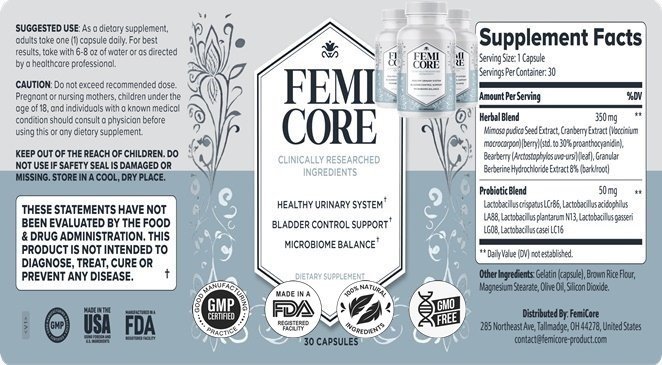
FemiCore Supplement Facts label
Here is the FemiCore label showing the ingredients and amounts per serving. Save or screenshot it to share with your doctor or pharmacist before you start.
References
- Pearce MM, et al. The female urinary microbiome: a comparison of women with and without urgency urinary incontinence. mBio. 2014. PubMed
- Stapleton AE, et al. Randomized, placebo-controlled phase 2 trial of a Lactobacillus crispatus probiotic given intravaginally for prevention of recurrent urinary tract infection. Clinical Infectious Diseases. 2011. PubMed
- Williams G, et al. Cranberries for preventing urinary tract infections. Cochrane Database of Systematic Reviews. 2023. PubMed
- European Medicines Agency. Community herbal monograph on Arctostaphylos uva-ursi folium. EMA
- National Center for Complementary and Integrative Health. Probiotics: what you need to know. NCCIH